PRESS RELEASE
Course correction in the healthcare system: Curbing rising expenditure, strengthening prevention
- Healthcare expenditure as a percentage of gross domestic product in Germany is among the highest in the OECD. By contrast, Germany shows only an average performance for key indicators of population health.
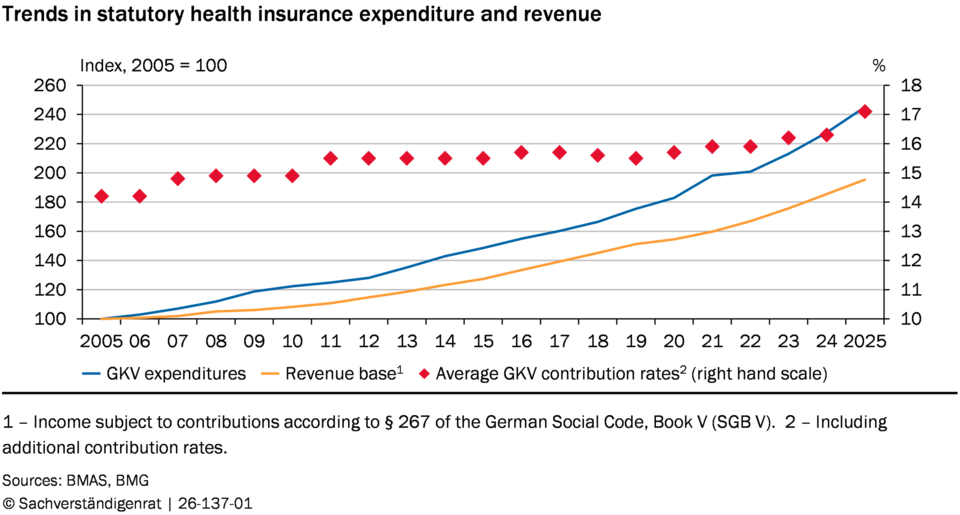
- Expenditures by the statutory health insurance (GKV) are rising faster than the revenue base. Alongside demographic ageing and advances in medical technology, this sharp rise in expenditures is driven by inefficient care structures.
- To curb further increases in GKV contribution rates, reforms are needed in particular to ensure more effective expenditure control in hospital care and pharmaceuticals.
To curb the rise in expenditure in the German healthcare system, financial resources should be used less inefficiently. “The statutory health insurance does not have a revenue problem, but an expenditure problem. There is no single solution that is sufficient to effectively curb the rise in expenditure. Rather, adjustments must be made across a wide range of areas,” says Martin Werding, council member. In particular, more efficient use of resources is possible in hospital care and pharmaceuticals and preventive healthcare should be strengthened. Furthermore, the non-contributory co-insurance for spouses who are not raising children should be abolished.
Healthcare expenditure as a percentage of gross domestic product (GDP) in Germany is among the highest in OECD countries. By contrast, Germany shows only an average performance for many key indicators of population health. Expenditure by the statutory health insurance (GKV) has risen by almost 64 per cent in real terms since 2005, whilst the contribution base has risen by only almost 31 per cent over the same period. Consequently, the contribution rate has been raised from 14.2 per cent in 2005 to a current average of 17.5 per cent. The German Council of Economic Experts (GCEE) expects that the contribution rate will have to be raised further to 19.8 per cent by 2040 unless countermeasures are taken.
Focus on expenditure efficiency
To improve expenditure efficiency in the long term, firstly, hospital funding should be made less dependent on case numbers, and remuneration should be more closely aligned with actual cost increases. Secondly, the services covered by the nursing care budget should be clearly defined to prevent care staff from being misused for non-care-related tasks. Thirdly, outpatient care and patient management along the care pathway should be expanded to reduce the number of avoidable (inpatient) treatments. Fourthly, the rise in pharmaceutical expenditure should be curbed by aligning the pricing of innovative pharmaceuticals more consistently with their additional therapeutic benefit.
Reform of non-contributory co-insurance for spouses
Reforms on the revenue side can also help stabilise the financing of the GKV, but they do not replace structural adjustments on the expenditure side. Abolishing the non-contributory co-insurance of spouses who are not raising children would relieve the burden on the GKV and, at the same time, strengthen the incentives for second earners to participate in the labour market. An appropriate health insurance contribution would need to be determined for spouses currently covered free of charge. This could be based on the current minimum contribution for voluntarily insured members of the GKV of approximately 220 euros. The non-contributory co-insurance of spouses involved in raising children should be retained.
Prevention reduces costs in the long term
Health prevention in Germany is underdeveloped compared to European standards. Information and education programmes provide an important foundation, but they are often insufficient to achieve a sustainable reduction in unhealthy behaviour. To make prevention more effective, standards for healthy eating in nurseries and schools should be made mandatory, and advertising should be restricted – for example for unhealthy foods. Higher taxes or minimum prices on tobacco, alcohol and foods high in sugar could also help to reduce consumption that is harmful to health.